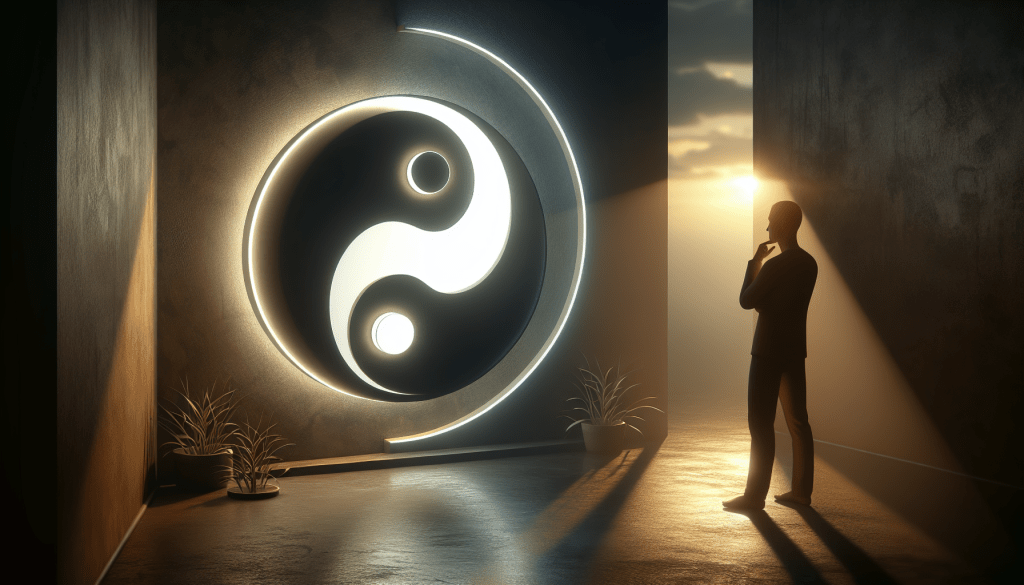
At some point in our lives, most of us grapple with the question, am I a good person or a bad person? This introspective query often surfaces during times of crisis, moments when we instinctively turn towards higher powers or internal reflection for guidance and reassurance. It’s during these times that our identity and morality are put under a microscope, scrutinised both by ourselves and by others.
When faced with adversity, it is not uncommon for people to pray, hoping for divine intervention to sway circumstances in their favour. Consider a situation where two individuals are praying for outcomes that are directly opposed to each other. For instance, one might be praying for personal success, which inadvertently might lead to another’s failure. Each party believes in the righteousness of their own cause and views themselves as the good person in their narrative. This leads to an existential dilemma: if both parties are praying for opposite outcomes, whom does a higher power favour? It raises the deeper question of how to judge goodness and who has the authority to decide what is right.
This idea is not merely theological, but extends into everyday judgments and decisions made by those in positions of authority, much like a judge in a courtroom. These authorities often have to decide who is at fault and who is innocent, heavily influencing how individuals are perceived in the societal moral spectrum. However, such decisions can be subjective and are influenced by laws, cultural norms, and personal biases.
The concept of being a good or bad person is deeply ingrained in our societal narratives. Each of us tends to see ourselves as the protagonist of our own story, often pitted against various antagonists or challenges. This good versus evil dynamic is reminiscent of stories like David and Goliath—tales that simplify the complex spectrum of human behaviour into clear-cut dichotomies. However, life is rarely this black and white.
Inside each of us, there is the seed of both good and evil. It’s a constant struggle as to which one will win. And one cannot exist without the other.
Eric Burdon
My therapist often points out that our perceptions can deceive us. What we think about ourselves or others isn’t always an accurate reflection of reality. The truth is, every person possesses a mix of traits that others may perceive as positive or negative, depending on the context. The notion of good and bad is not fixed; it’s fluid, influenced by a myriad of factors, including our actions, intentions, and the circumstances we find ourselves in.
This complexity suggests that categorising ourselves or others as purely good or bad is not only reductive but also potentially misleading. Instead, it might be more accurate to consider that everyone exhibits shades of moral grey. Each person’s actions and thoughts exist on a spectrum where sometimes we may act out of alignment with our own ideals, and at other times, we may live up to them admirably.
Understanding this nuanced view of morality requires us to be empathetic and introspective. It encourages us to question not only how others perceive us, but also how we perceive ourselves. It compels us to reflect on our intentions, our actions, and their impact on others. Whether we are good or bad is not a static state, but a continuous journey of moral and ethical evaluation. It’s a personal exploration where the ultimate authority isn’t an external judge or even a divine force, but our ongoing commitment to self-awareness and integrity.


Leave a comment