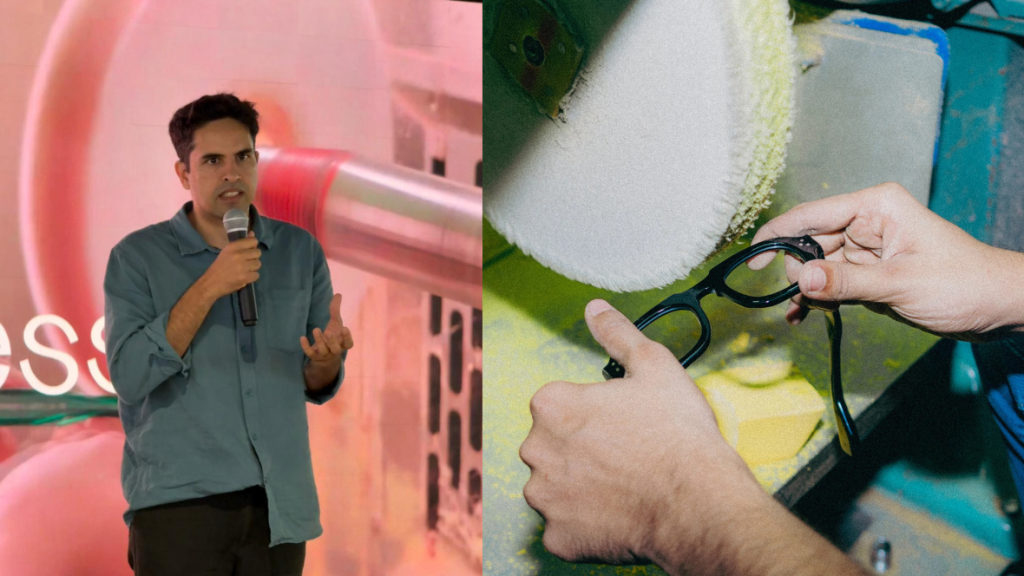
COCO LENI, founded by Arjun Sagar, is built on a simple idea: eyewear should feel personal. Based in Goa, the brand focuses on craftsmanship, precision, and a slower way of making products designed to last. In this interview, he reflects on building COCO LENI, staying true to that philosophy, and choosing the long road in a fast-moving world.
1. What first led you to start COCO LENI? Was there a particular moment or realisation that made you feel this brand needed to exist?
There wasn’t one dramatic moment. It was more of a slow frustration building over time. I couldn’t find eyewear that truly fit well or felt personal. Everything was either mass-produced or designed for a generic face. There was no intimacy in the product.
That’s when I started asking a simple question: what if eyewear was made the way it should be made, for the individual, not the market?
COCO LENI came from that pursuit. Not to sell frames, but to build something precise, personal, and long-lasting.
2. Eyewear brands like Lindberg from Denmark and Matsuda from Japan have built global reputations around craftsmanship and a strong design language. Do you see COCO LENI as an Indian response to that kind of legacy, or are you trying to carve out something entirely different?
I deeply respect brands like Lindberg and Matsuda. They’ve shown that craftsmanship and design integrity can build a global legacy.
But COCO LENI isn’t trying to imitate or respond. We’re building something rooted in our own context: India, Goa, our materials, our hands, and our pace. If anything, the intention is to prove that a global standard of craftsmanship can come from India, without copying the West or Japan.
3. In a time when startup culture often celebrates “moving fast and breaking things”, COCO LENI seems to embrace a slower and more deliberate approach. How did you arrive at that philosophy?
Speed works for distribution, but it does not work for craft. When you rush something handmade, you lose the very thing that makes it valuable.
We chose to go slower because every frame is made in-house, every material behaves differently, and every face is different. You cannot scale this the way mass-produced products or software scale.
Our belief is simple. If you build something well enough, it does not need to be replaced.
4. Building a brand with such a distinct identity can be challenging in a market driven by trends. What have been some of the biggest challenges in staying true to your vision?
The biggest challenge is saying no constantly. No to discounts, no to shortcuts in production, no to mass manufacturing when demand increases, and no to trends that do not align with our design language.
There is always pressure to dilute, especially when the market rewards speed and volume. But every time you compromise, you weaken the brand.
5. When you think about the future of COCO LENI, what would you ultimately like the brand to stand for?
I want COCO LENI to stand for three things, very clearly:
- Handmade in Goa, not outsourced or assembled.
- Built to last, repairable, durable, and meant to age.
- Fits that actually fit, not one size fits all.
I do not want COCO LENI to be seen as just an Indian brand. I want it to be a benchmark for how eyewear should be made. If someone anywhere in the world thinks of precision, longevity, and honesty in eyewear, COCO LENI should be part of that conversation.
6. Entrepreneurship is often discussed through success and milestones, but rarely its personal cost. What has building COCO LENI demanded from you personally?
A lot of patience and a lot of letting go.
You start with control over design, product, and decisions. However, as you grow, you have to start trusting people, systems, and time. There have been financial risks, operational stress, and long periods of uncertainty.
More than anything, it demands consistency of belief. You are building something that does not always make sense in the short term. You do not get immediate validation.
You are choosing the long road every single day.


Leave a Reply