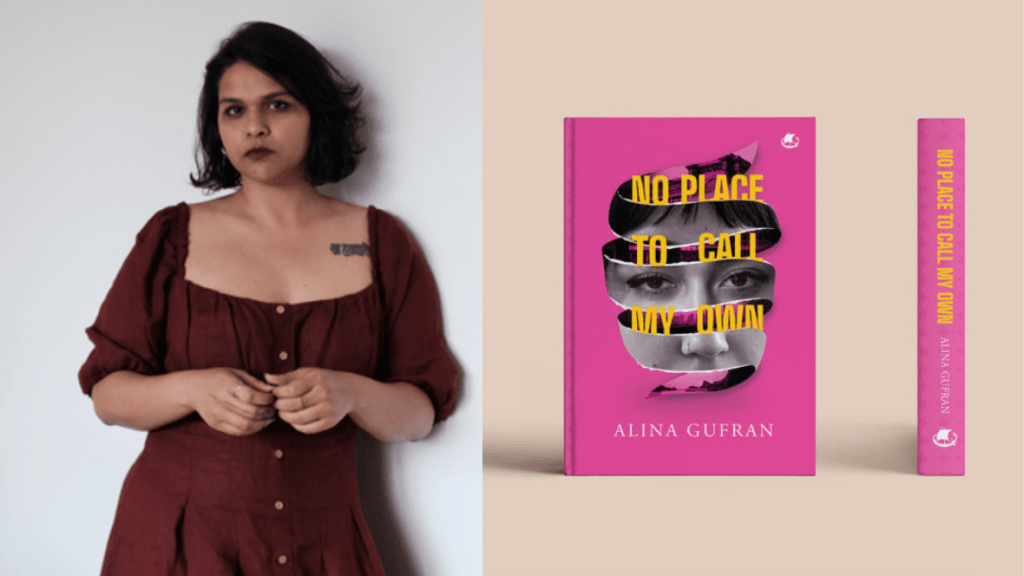
Alina Gufran’s No Place to Call My Own offers a raw and unfiltered look at identity, belonging, and the turbulence of one’s twenties. Through complex, flawed characters, the novel explores relationships in a way that feels deeply real and relatable. In this interview, Alina shares her journey of writing the book, the inspiration behind its themes, and the challenges of the creative process.
Before we dive into the interview, I just wanted to say how refreshing it is to see characters with their own strengths and flaws, rather than the perfect ones often found in Indian literature. The complexity of Medha and Sophia’s relationship in the book particularly stood out to me—both multifaceted and, in some ways, straightforward. The way Sophia battles the urge to text Medha while also taking pleasure in shutting her out is such an honest take on modern friendships.
1. No Place to Call My Own delves into themes of identity and belonging. What personal experiences or observations inspired you to explore these themes in your debut novel?
A lot of it is deeply rooted in my own experience of growing up between cultures—as the child of immigrants, I was constantly aware of the tension between home as a physical space and an abstract idea; something you have to build rather than inherit. I’m also drawn to the way class, gender, desire, religion intersect with displacement. The lives of people around me—stories of migration, exile, forced departures also informed the novel. I wanted to capture that emotional landscape: the grief of never fully belonging, but also the defiant joy of carving out a space for oneself, however fragile.
2. The protagonist, Sophia, navigates complex relationships and societal expectations. How did you approach developing her character, and were there any challenges in portraying her journey authentically?
Sophia’s character emerged from a desire to explore the contradictions and pressures that shape a woman’s sense of self, especially one caught between multiple worlds. Developing her was a process of allowing her flaws to exist without apology. I resisted the urge to make her wholly likable or easily understood because real people aren’t. One of the biggest challenges was ensuring that her inner conflicts—whether about love, family, or belonging—felt layered rather than didactic. I drew from my own experiences of displacement and conversations with women who have felt similarly unmoored.
Another challenge was portraying her relationships authentically, particularly the way intimacy and power intersect. Sophia’s relationships—romantic, familial, platonic—are fraught with unspoken expectations, cultural baggage, and the weight of personal and political history. I wanted her to feel real—not a symbol, not a statement, but a person navigating the impossibilities of belonging in a world that often refuses to claim her.
3. Your novel offers an intimate portrayal of millennial disquiet in a volatile world. What message or reflection did you hope to convey to readers through this narrative?
I didn’t set out to deliver a singular message, but rather to capture a feeling—of restlessness, of searching, of never quite arriving. No Place to Call My Own is, at its core, about what it means to live in a world that constantly shifts beneath your feet, where home is an unstable concept and identity is shaped as much by external forces as by personal choice. For millennials, especially those from postcolonial, migratory backgrounds, there’s an acute sense of precarity—not just economic, but existential. We are told we have endless possibilities, yet find ourselves boxed in by history, family, politics, and the sheer exhaustion of survival. Through Sophia’s journey, I wanted to reflect the ways in which this generation grapples with intimacy, ambition, and selfhood.
4. How much of the novel was inspired by real-life experiences, and how much was purely your own creation? Did you find yourself drawing from personal moments while writing?
The novel is deeply personal, but it’s not autobiographical. Many of Sophia’s emotions—her sense of displacement, her restlessness, her search for meaning—are drawn from my own experiences, but they’re reshaped and reimagined through fiction. I found myself borrowing details from memory, but the story itself took on a life of its own.
5. Balancing creative endeavors with deadlines can be mentally taxing. How do you manage the pressures of writing within set timeframes, and what strategies do you employ to maintain your mental well-being during such periods?
Rituals help—whether it’s morning pages to clear my mind, writing early morning or late at night when the world is asleep, or stepping away for a walk or a workout when I feel stuck. I also prioritize rest, knowing that burnout only dulls the work. I often have to strike a negotiation between intensity and stillness, and I often find the act of writing far more enjoyable than any idea of the final product.
6. The title, No Place to Call My Own, is deeply evocative. How did you arrive at this title, and how do you feel it encapsulates the essence of the story?
I wanted a title that felt both intimate and expansive, something that could speak to personal alienation as well as political. The title was given to me by an early reader and close friend and it somehow just fit.
7. The book moves between cities instead of following a conventional chapter style, with flashbacks woven into the narrative. Was this structure a deliberate choice to mirror Sophia’s sense of displacement?
Yes, the structure was very much a deliberate choice. Sophia’s sense of displacement isn’t just thematic—it had to be embedded in the very form of the novel. The cities act as emotional anchors rather than mere settings. The narrative moves fluidly across time and place, much like memory itself—fragmented, recursive. The novel’s structure is an extension of its emotional landscape.
But they never taught me how to cook or love my body or build relationships or even accept pain so it won’t stick to everything I say or do until it erodes me. Maybe I was born rotten.
Alina Gufran, No Place to Call My Own
 Bhumik’s Anxious Moments
Leave a comment